The Rushford Estate lies in
beautiful unspoilt countryside on the
Norfolk/Suffolk border near the hamlet of Rushford. It has a long,
distinguished history and was once owned by Edmond Gonville, the rector
of Rushford between 1326 and 1342 and founder of Gonville &
Caius
College at Cambridge University.
In 2009 the Estate was acquired
by the current owners who continue
to run it as a traditional East Anglian farming estate.
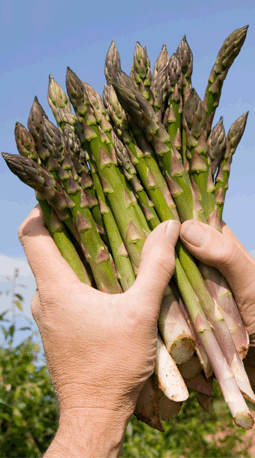
Rushford Estate Asparagus
Asparagus grows particularly
well in the light, productive soil at
Rushford and the Estate has a long standing and fine reputation for
growing the crop. At Rushford it is harvested daily, washed, graded and
bunched by hand in the traditional manner.
The English asparagus season is
a short six week period from early
May to the end of June. The fresh succulent green spears are very low
calorie, high fibre and packed full of vitamins and minerals. It is
also well known as an aphrodisiac!
Rushford asparagus can be
bought directly from the pack house -
locally produced fresh and healthy food with virtually no food miles.
The remainder is sold through outlets in the capital and to local
hotels and restaurants.
Our shop is open from 8.30am
until 6pm weekdays and 10am until 2pm
weekends. Blink and you could miss it - make the most of the short
English season.
You can email or call us
direct on the address and numbers listed
on the Contact
Us page. Or please visit
us at the Estate Shop to buy fresh asparagus direct from the pack
house.
Shop Opening times
Mon - Fri 8.30am - 5:00pm
Sat - Sun/Bank Holidays 10:00am - 2:00pm
How Asparagus Grows?
Asparagus plants are started in
greenhouses with seeds. It takes one
year to grow the "crown", or the part of the plant that produces the
spears we eat. After a year the crown is ready to plant in the ground,
and it will produce spears for about two weeks the first year. As the
plant matures it can produce more and more spears each year. Older
plants can produce spears from one crown for six weeks or longer. New
spears can appear on a crown every day, so when it's asparagus season,
tender new spears can be picked every day. . The soil must be deep,
rich and sandy. If the plant is allowed to grow for three years before
it is cut, it will continue to bear an annual supply for some nine
years or more, but the soil must be fertilized every year to maintain a
good yield.
The remarkable thing about the asparagus plant is that it produces both
the tender shoots which we eat, and the fern-like foliage which we use
for decorative purposes. Asparagus for the table is cut while the
leaves are still in bud and the shoot is less than ten inches high. If
asparagus is left to grow, it becomes a plant two or more feet high
with spreading branches bearing small, white flowers and brilliant, red
berries. When the crop is gathered, some of it is tinned, and some
rushed fresh to city markets where it is sold in bunches. In Europe,
asparagus is often dried soft can be used in the winter.
Asparagus may be grown from seeds, or roots may be planted in a shallow
trench which is later filled in gradually.
Types of Asparagus
There are three varieties of
asparagus—green, purple and
white. The green variety is the most common. The white variety is grown
without exposure to sunlight. The reason why it's white is because the
plants don't produce any chlorophyll when they don't get any sunlight.
The purple variety is rare in the U.S. but can be found in some
supermarkets in Europe.
At The Rushford Estate we grow only the green variety, however within
this variety you can choose from four very different grades, they are:
 |
Class
I - Extra Select
The finest grade, the spears are 16-20mm thick
(approx 10 spears per 1 lb bundle) |
|
|
Class I - Select
Spears are 10-16mm thick
(approx 16 spears per 1 lb bundle)
|
|
|
Class
I - Choice
Spears are 6-10mm thick
(approx 30 spears per 1 lb bundle) |
|
|
Class
II
- Kitchen
Spears will be any thickness |
We also do a
kitchen grade of
witch consists of asparagus of all
sizes but don't meet the class 1 quality at the bud. This is mostly
used for making soup as it is all pureed together and the flavour is
all that is needed.
Asparagus is a
perennial plant
native to central and southern
Europe, northern Africa and western and central Asia. It is a member of
the lily family, which includes plants such as onion, garlic, leeks,
turnips, lilies and gladioli.
Wild asparagus was loved by the ancient Greeks but it was the Romans
who first cultivated it. Asparagus, (Asparagus officinalis), comes from
the Greek word asparagos, which first appears in English print around
1000 A.D. It cannot be definitively tracked to any one specific area of
origin, although it is known to be native to the eastern Mediterranean
and Asia Minor areas.
As early as 200 BC, Cato gave excellent growing instructions for
asparagus. The ancient Egyptians cultivated it, and Romans, from Pliny
to Julius Caesar to Augustus, prized the wild variety.
The Emperor Augustus coined the phrase 'velocius quam asparagi
conquantur', meaning to do something faster than you can cook
asparagus. Julius Caesar first ate it in Lombardy and wanted it served
with melted butter. And in the time of King Louis XIV asparagus was
dubbed 'The King of Vegetables'.
Herbalist John Girard mentioned wild asparagus in the 16th century, and
it is mentioned as far back as the 17th century in French cookbooks.
The asparagus growing beds in Northern Italy were famous during the
Renaissance period. These graceful spears have always been a sign of
elegance, and in times past, were a delicacy only the wealthy could
afford. Roman emperors were so fond of asparagus, that they kept a
special asparagus fleet for the purpose of fetching it.
Early American Indians dried asparagus for use later or to make
medicine. In the dry, arid lands it is especially useful as a natural
diuretic or for bladder and kidney problems. It contains a factor in
preventing small capillary blood vessels from rupturing and was used
for heart problems. A wholesome vegetable drink can be made from the
cooled cooking water of asparagus as long as it is not salted too
heavily.
As early as 200 B.C. the Romans had how-to-grow directions for
asparagus. They enjoyed it in season and were the first to preserve it
by freezing. In the 1st Century fast chariots and runners took
asparagus from the Tiber River area to the snowline of the Alps where
it was kept for six months until the Feast of Epicurus. Roman emperors
maintained special asparagus fleets to gather and carry the choicest
spears to the empire.
One could say asparagus is truly an international food. With its high
tolerance for salt and its preference for sandy soils, wild asparagus
grows in such diverse places as England, Russia, Poland and Oklahoma.
Asparagus is depicted in ancient Egyptian writings. Asparagus has also
been grown in Syria and Spain since ancient times.
Asparagus is highly versatile. In China, asparagus spears are candied
and served as special treats. It is widely popular today as a
scrumptious, fresh, and healthy vegetable.
Asparagus has been considered one of the finest table delicacies since
the days of the ancient Greeks and Romans. Yet strangely enough,
asparagus grows wild around the coasts of Europe and in other sandy
places.
Of the 150 species of asparagus widely distributed in tropical and
temperate countries, many species are only cultivated for ornamental
purposes. Wild asparagus grows on the south coast of England.
England
produces arguably the
tastiest asparagus in the world, for
about 8 weeks between April and June. Because of the cooler climate in
England, the asparagus spear takes longer to grow and therefore the
flavour is enhanced.
Preparation
We have already washed and trimmed, unlike other suppliers, all our
asparagus is ready to use.
Time of cooking
As a general rule, asparagus is cooked when the tips are tender, but
not soft to the point of a knife. Caution! asparagus is very
fresh so it will need less cooking.
Steaming
Lay the lightly salted asparagus flat in the top of a steamer over
boiling water. Cover and steam for approx 6 to 8 minutes.
Boiling
Tie the asparagus in bundles, or leave the band on, and stand in 2
inches of lightly salted boiling water. Cover the tips with foil to
catch the steam. This ensures that the stalks cook in water, but the
delicate tips cook in steam. About 6 to 8 minutes.
Microwave
Arrange the spears lengthwise (tops in centre) in a baking dish and add
2 serving spoons of water. Cover, and microwave on HIGH for 3 minutes.
Rotate the dish a half turn, then microwave for another 2 minutes.
Allow to stand before serving.
Grilled
Lightly brush spears with olive oil, season with salt and pepper to
taste. Grill with medium heat (turn once) for about 3 minutes to
desired tenderness. Serve as an appetiser with cured meats.
 How
to buy
How
to buy